
I have been working on musical instruments the last couple of years. Way back when I had the use of a bowl-back mandolin that I rather liked, but as with so many things, I had to give it back. So, given that these days I’ve taken to just making things I want, but also remembering the error of starting with ukuleles, I thought perhaps a lute style guitar would be a happy medium.
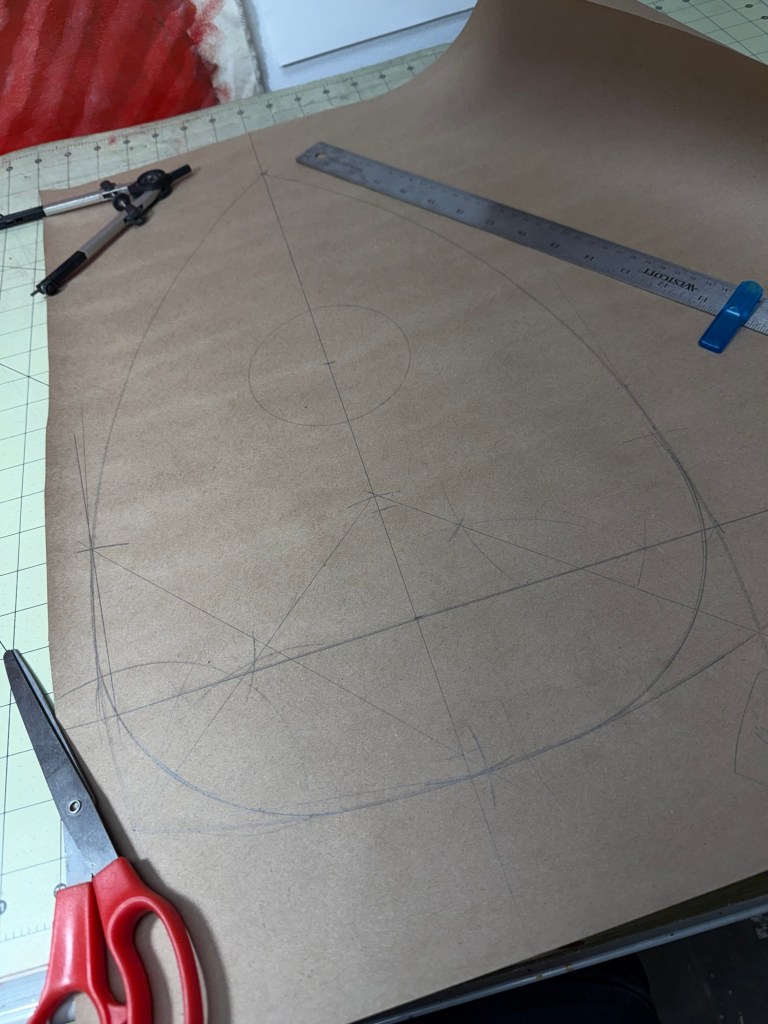
From a book on traditional lute construction I found some vague ideas about how the shape was derived from some related circular arcs. And I figured to make life easy, I’d start with a semicircular bowl profile.
For the curious, given a cross shape, centered on the rough location of the bridge, measure up the scale length. Then find the rough position of the 7th fret, or 2/3rds up the line from the bridge. Using that point as the center, use a compass (or a set of trammel points to describe an arc a little distance behind the bridge. This distance is a bit arbitrary. On lutes it seems to be about 4” or thereabouts. You’ll want to be flexible though. Make it pretty.
Measure out the width, and with the compass at the same setting as before, put the pencil end down on that line an inch or two in front of the bridge (towards the neck) and put the point of the compass on the horizontal line from the bridge location. And draw another arc in each side.
Lastly fill in the bottom corners with circular arcs that blend in with the previous curves. The way I did it here is to draw a circle with its center at the meeting point of the two side arcs. Which gives you two points on the side curves equidistant from the corner. If you then bisect the angle from the two side curves, you just need to find the point on that bisecting line that will let you draw a circle that is tangent to the other two curves.
You can see the way I drew it in the picture. This is kind of arbitrary and the style seems to have changed a lot over the years.
More to come…

 Creative Yen Acts